
It is not uncommon for researchers/engineers/biologists/chemists/… to consult a statisticians after the data collection is completed.
Design Decisions are Irreversible
Many mistakes cannot be fixed after data are collected: Underpowered study, confounding factors, lack of randomisation, missing controls, failure to measure key variables to name a few.
Reframe Statisticians as Collaborators, not Service Providers
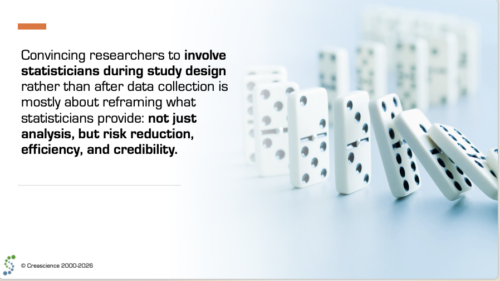
Many researchers think of statisticians as the person who runs the statistical analyses/build statistical models. Statisticians are experimental design specialists.
Design Saves Time & Money
Researchers often think consulting a statistician slows them down, but in reality it usually reduces experiments.
- Factorial designs can evaluate several variables simultaneously.
- Fractional factorial designs can screen many factors in very few runs.
- Power analysis prevents underpowered studies.
In my experience, a 90-min discussion can help save months of experimentation.
Increased Publication Success
Many journals and reviewers now look for: power analysis, randomisation, pre-specified analysis plans, appropriate statistical design. Poor design often leads to: reviewer rejection, requests for additional experiments, inability to support claims.
Good design makes papers easier to publish and defend during peer review.
Lack of Statistical Rigour & Failure Dtories
- A lab collected data but “forgot” to randomise treatment order → confounded results.
- A clinical or animal study lacked proper blocking or stratification.
When researchers start realsing that months of work can become unusable, they start valuing early statistical input.
Make Early Consultation Easy
Not all companies/institutions can afford a full-time statistician.
We offer mentoring to those who cannot afford a full-time statistician. https://lnkd.in/eT6DdMre
Statistical Rigour Tied to Funding & Grants
unding agencies increasingly expect strong statistical planning. Grant proposals often require: justification of sample size, analysis plan, experimental design, etc.
Educate Researchers about Interactions & Hidden Structure
Many researchers default to simple approaches because they do not realise what they are missing. I can think of interactions between factors, batch effects, blocking, hierarchical structure, pseudo-replication, etc.
Promote the Idea that Study Design is Part of Scientific Thinking
Good study design clarifies: the research question, existing sources of variation, what evidence will be convincing, and so much more. This aligns statistics with the core scientific method, not just statistical calculations.
Quite frankly, I prefer contributing to well-designed studies from the outset rather than attempting to salvage flawed designs later.